Inside Hardin County EMS — Meet Director Mark Peterson
For National EMS Week, Director Mark Peterson takes us inside Hardin County EMS — the 9th ambulance in White Mills, what a half-million-dollar rig carries, when to call 911, and how to thank a crew.

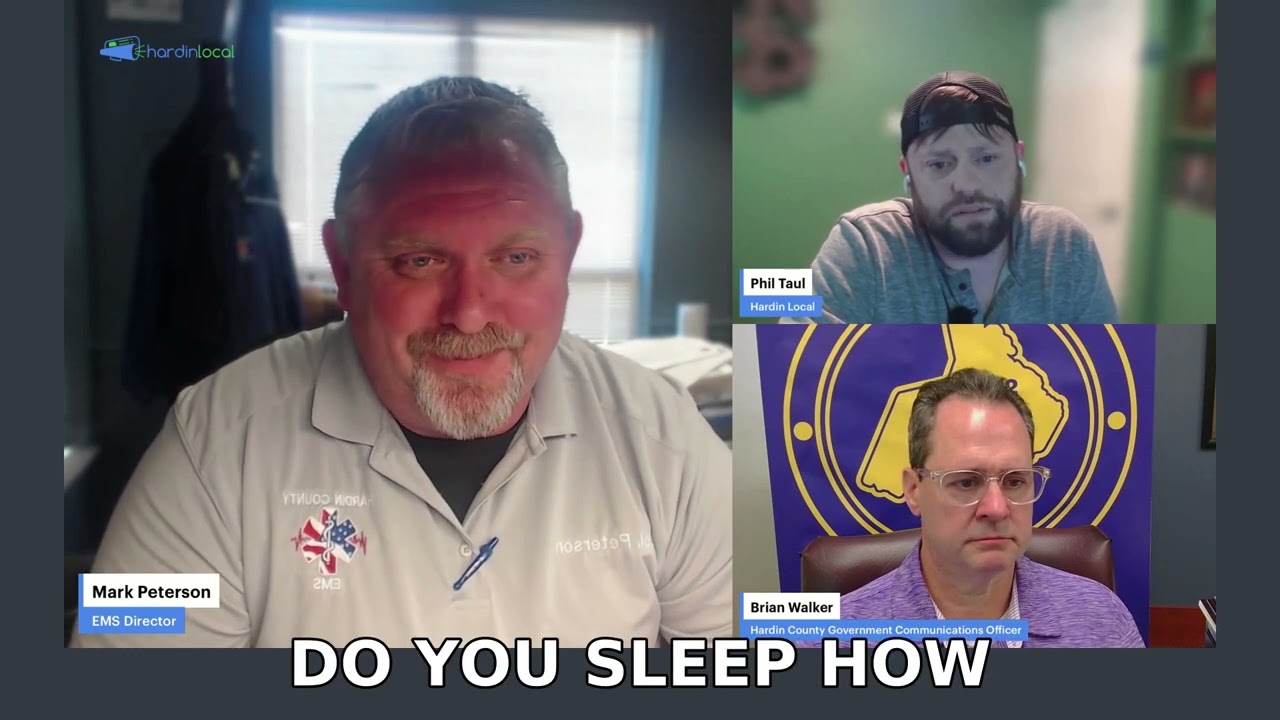
National Emergency Medical Services Week runs May 17–23, and this month on Hardin Local with Hardin County Government we marked it by going inside the department itself. Hardin County EMS Director Mark Peterson joined host Phil Taul and county communications officer Brian Walker for a look at the people, the equipment, and the everyday calls that keep this service running.
The 9th ambulance, six months in
Back in November, Hardin County stood up its 9th ambulance at the renovated West Hardin Fire & Rescue station in White Mills. Six months later, the numbers tell the story: that station now handles roughly 50–60 responses a month, and response times in the area have dropped from 40–45 minutes down to 15–20 minutes.
One detail that surprised us — total calls in the area are actually up, not down. As Mark explained, that's the point: people who used to load up and drive themselves to the hospital now know help is close enough that it's worth calling.
The people behind the call
Mark walked us through what it takes to staff an ambulance, and the training ladder behind those uniforms:
- EMT, AEMT, and paramedic are three different levels of certification and capability — not interchangeable titles.
- Crews work demanding 24-hour shifts.
- Hardin runs its own in-house ambulance repair garage — about three years old now — something most counties outsource. It saves money and, just as importantly, keeps rigs in service instead of sitting in a shop.
- Hardin is one of the few counties that offers a hazardous-duty retirement benefit for EMS, on the same tier as police and fire — a real advantage in recruiting and keeping experienced crews.
Inside the rig: a rolling ER
Then we went inside the ambulance itself. A modern rig runs close to $500,000 and functions as a mobile emergency room — cardiac monitors, IV lines, advanced airway equipment, and the medications a crew needs to start treatment the moment they arrive.
A standout is the Stryker Lucas device, which delivers uninterrupted mechanical chest compressions at the right depth and rate. It doesn't tire, it doesn't miss a beat over bumps in the road, and it means no one has to stand unbuckled in the back of a moving ambulance to perform CPR.
When to call 911 — and what to expect
Some of the most useful minutes of the episode were the practical ones. A few takeaways for residents:
- When in doubt, call. EMS would much rather respond and find everyone okay than have someone wait too long.
- The dispatcher's questions do not delay your ambulance. Help is already rolling while you're on the phone — the questions help the crew arrive ready. (Confirmed on-air by a viewer who supervises E-911 and chiefs a local fire department.)
- You can refuse care if you're able to make that decision — but talk it through with the crew first.
A small thing that can save real minutes in a rural emergency: make sure your house number is visible from the road, day or night. Crews can't help at an address they can't find.
Free tools worth knowing
The team ran through a list of resources — most of them free — that residents can put to use today:
- RAVE Alerts — free, county-managed notifications for weather and roadway shutdowns. Sign up at HardinCountyKY.gov.
- PulsePoint — reconnecting after E-911's recent dispatch-system upgrade; a relaunch is expected shortly.
- Narcan — free dispensers around the county, plus leave-behind kits through Hardin County's Quick Response Team.
- Stop the Bleed — bleeding-control and tourniquet training.
- File of Life — a simple card listing your medications, allergies, and contacts, kept on the fridge or in a wallet.
- Yellow Dot — a UofL partnership; a windshield sticker points first responders to an info card in your glove box.
- Teddy Bear Clinics — held with E-911 at local schools.
- Your phone's Medical ID — accessible from the lock screen, a tip a viewer raised and Phil demoed live.
The ask: thank a crew this EMS Week
The headline of the episode is a simple one. If you'd like to thank Hardin County's EMS crews during National EMS Week — a card, donuts, a pizza for a station — reach Jennifer Kant at [email protected] or 270-599-2967, and she'll help spread it across all five stations.
For non-emergencies, Hardin County EMS can be reached at 270-769-3014. And as always — if it's an emergency, call 911.
Hardin Local with Hardin County Government is a monthly conversation putting a face to the county offices that serve Hardin County. Watch the full episode above, and find more at HardinLocal.com.