The Cameras Already Know Your Car. So We Asked the People Watching Them.
At least 67 license plate cameras are watching Hardin County roads. We sat down on camera with the police chiefs running them and asked every uncomfortable question, including what happens when one of their own abuses it.

If you drove into Elizabethtown today, there is a very good chance a camera photographed your license plate, logged the time and location, and noted the make, model, and color of your vehicle. Not because you did anything wrong. Because you drove past it.
When Elizabethtown's police chief briefed city council in late 2023, the city had 20 Flock cameras, and the pair at Ring Road and North Dixie alone were reading about 50,000 plates a day.1 Today, Chief Jeremy Thompson told me, EPD operates 40 cameras, with five more just approved. Radcliff runs 17 and has six more in this year's budget. The Sheriff's Office has 10, and here is the thing I did not know until after this published: all ten of them are on school property. The Sheriff's Office confirmed that on July 30. Its entire plate-camera deployment is at schools, under the program it runs with Hardin County Schools where police and not the district control the data.2 Not one Sheriff's Office camera is watching a road.
That settles a question this article originally left open, and it settles it in the direction of a smaller number, not a bigger one. There is no separate stack of school cameras sitting on top of the Sheriff's 10. They are the same ten. So the county total is 40 plus 17 plus 10, which is 67. Vine Grove has a handful of its own that I did not get to. Call it at least 67 plate cameras in Hardin County right now, with more already funded.
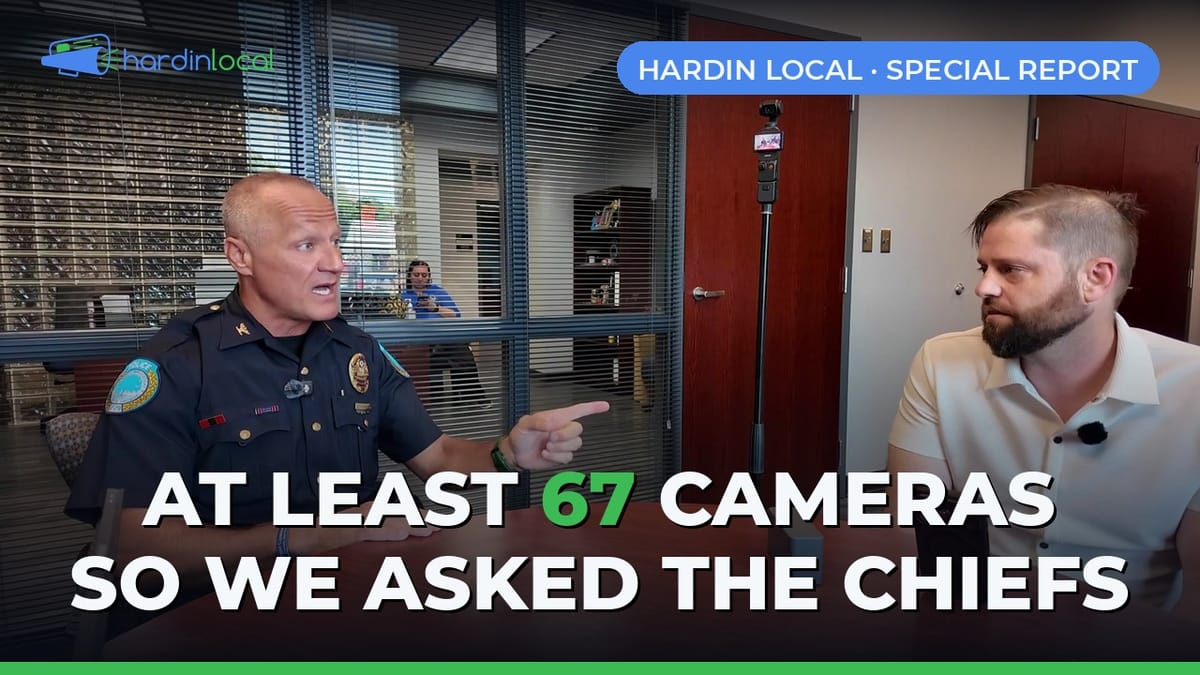
I started researching this article skeptical, and I will be honest with you about something: my first draft was written before I had spoken with a single local officer, and it leaned hard on stories from other places. Then I sat down for almost an hour with Chief Thompson and Lt. Alex Ruiz of EPD and Chief Jeffrey Cross of Radcliff PD, on camera, with every question on the record. The Sheriff's Office answered my questions in writing through an open records request. This version of the article is built on what they actually said.
Here is what I found: the concerns you have read about this technology are real, and they happened, in other towns. What I found here was different. I found local leaders who answered every uncomfortable question I asked, on camera, and who talk about auditing their own officers the way you would hope they would. We are fortunate in that regard, and I do not say that lightly.
Update, July 30, 4:00 PM. The Hardin County Sheriff's Office answered my outstanding questions a few hours after this published. Their answers resolve almost every open item in this article, and one of them changed a fact I had wrong. All ten of the Sheriff's Office's cameras are on school property. Not a single one is on a road. Their retention is 30 days, their audits run monthly, and their audit logs cannot be edited or deleted. The full answers are folded into the sections below and marked. I said this article would be updated when they came back, and this is that update.
The quick version
This is a long article, on purpose, because the details are the whole point. But if you read nothing else, read this:
- At least 67 plate-reading cameras are running in Hardin County right now, with more already funded. Elizabethtown has 40 and five more approved, Radcliff has 17 with six more budgeted, and the Sheriff's Office has 10. All ten of the Sheriff's are on school property, not roads. Vine Grove has a handful I did not get to.
- They read plates, not faces. Plate number, make, model, color, and details like a dent or a bumper sticker. They are not traffic cameras, they do not write tickets, and they are not facial recognition.
- The pictures are kept 30 days at all three agencies, then they are gone. Kentucky's new law would let them keep the data for 90. All three chose not to. The Sheriff's Office confirmed this directly on July 30: "They can be held up to 90 days, but our policy is 30."
- Nobody can just go looking. Every search requires an individual login, a case number, and a specific offense from a defined list. A camera alert by itself is not grounds to pull you over; the plate has to be confirmed by eye first.
- They audit their own officers, but you cannot see the audits, and the three agencies do not audit the same way. Elizabethtown checks every user monthly. Radcliff and the Sheriff's Office each sample at least ten searches per cycle, both monthly. The gap is not how often, it is how much. None of the three publishes results, and HCSO has said in writing that it will not.
- All three written policies are linked in this article. Read them yourself instead of taking my word for it.
- The biggest thing nobody has decided is also the one that matters most: how long those audit logs have to be kept. It is not the only loose end, and there is a full list of them near the bottom, but it is the one everything else depends on. The new state law is silent on it, and no local agency has formally classified them yet. Elizabethtown told me, after reading this draft, that the underlying access log is kept indefinitely. That is good news. It is still unclear whether that is a binding rule or just the current setting, and I have asked. Every documented abuse case in this article was caught by a log that survived long enough for somebody to read it.