Hardin County Road Department: Why Paving Stops in Winter and How Snow Removal Really Works
Why asphalt plants close for winter, how the county clears nearly 600 miles of road with limited crews, and which roads aren't the county's job at all — with Road Supervisor Dwight Morgan and Michael Steck.

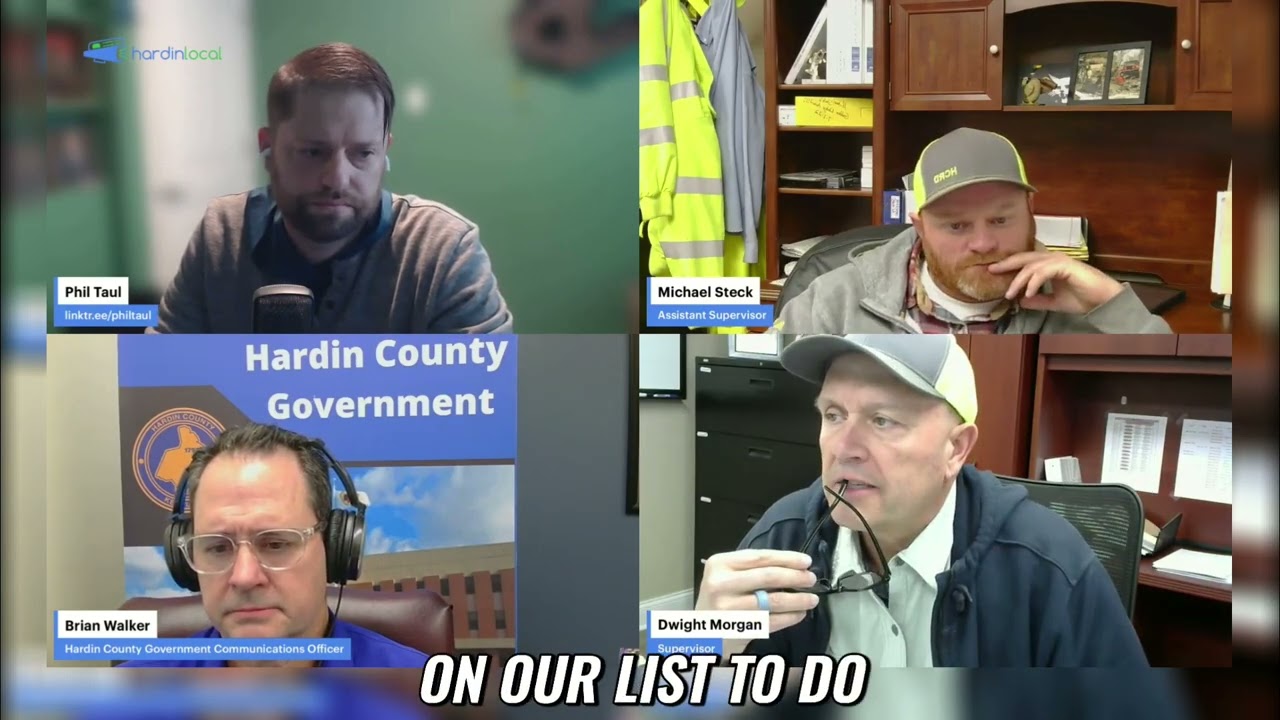
Everybody in Hardin County uses the roads, but few of us know what it takes to keep them open. This month on Hardin Local with Hardin County Government, hosts Phil Taul and Scott Lucas, along with county communications officer Brian Walker, sat down with two people who manage that work every day: County Road Department Road Supervisor Dwight Morgan and Assistant Road Supervisor Michael Steck. The conversation covered the end of paving season, the winter snow plan, and a handful of misconceptions worth clearing up.
Why paving stops for the winter
If a road crew was working near you and then suddenly stopped, here's the reason: asphalt plants shut down for the winter. As Dwight explained, paving usually ceases after Thanksgiving because the ground gets too cold — crews need it above 40 degrees to lay asphalt. Plants run from early spring to roughly Thanksgiving, then close so equipment can be repaired over the cold months before starting again in spring.
To decide what gets paved, the county scores its roads 1 to 10 (10 being worst) and works from the worst down; right now it's around the sixes. Road evaluations are now handled by a third party through the Lincoln Trail Area Development District for an unbiased assessment, and the overall county pavement score sits at about 70 percent — good, Dwight noted, compared to many other areas.
County, city, or state — they're not all the same
One of the biggest sources of confusion, Brian said, is simply who is responsible for which road. Just because a road sits inside the city doesn't make it a city road. The classic example: US 62 and Dixie Highway run right through Elizabethtown, but they are state roads, not city streets — as is Highway 86 out in Cecilia.
There's an easy way to tell them apart:
- State roads have a route number (US 31W, KY 1375, 210, and the like) and are usually striped.
- County roads have green name signs.
- City streets use their own sign colors, distinct from the county green (the hosts noted the exact city colors vary).
Michael and Dwight also noted that the county has spent zero dollars on the roundabouts — that work is funded with federal money, not the county road budget. The bottom line, the team stressed, is that the county has no control over how the state or cities maintain their own roads, so it helps to know who to call before you get aggravated about a road problem.
How snow removal actually works
The county maintains nearly 600 miles of road (Dwight put it at about 569). When fully staffed, the department runs about 15 trucks and 17 licensed drivers across five snow areas, each split into an A and a B route covering some 900 roads.
That limited crew is why the county can't run trucks around the clock. Michael, who reworked the snow routes with Nick Douthitt for efficiency, said drivers often start at the far end of a route and work back toward town, so a truck low on salt is closer to the shop for a reload.
"After about 12 hours in a plow truck, your fatigue gets so bad that your productivity goes way downhill." — Michael Steck, Assistant Road Supervisor
For a typical event the team can cover every road in roughly 12 to 15 hours, barring major breakdowns, working in daylight for safety. Snow isn't cheap, either: salt runs about $110 a ton, and a single four-hour snow the week before the show used roughly 125 tons and cost about $25,000 in salt and labor.
Salt isn't magic
A common belief is that you just salt the road and the snow disappears. As Dwight explained, it's all temperature-related — once it drops below about 20 degrees, salt is far less effective. The biggest help is actually sunlight, which warms the asphalt so the salt can work. That's why heavily shaded county roads, where tree canopy blocks the sun, stay colder and clear more slowly than open city streets and highways. For especially dangerous spots, the department installed snow gates on Colesburg Road and Miller Road — steep stretches that get closed during storms and reopened with specialized equipment once the rest of the routes are clear.
Inside the department
Snow is only part of the job. The road department runs an in-house shop that services its own trucks and vehicles for other county agencies, plus crews for signs, dirt and ditch work, roadside mowing, and tree trimming — clearing overhead canopy is one of their most valuable winter tasks because it lets more sunlight reach the road. The crew carries about 19 employees and was recently at capacity, though several are nearing retirement, so future openings are expected. Dwight also reminded viewers that road work is genuinely dangerous — crews stand beside live traffic every day, so slow down when you see them working.
How to report a problem and stay informed
For potholes, downed signs, and similar issues, the team recommends TextMyGov, the county's general notification and reporting system — sign up at hardincountyky.gov. For bigger issues, a phone call to the office works too. A few key reminders from the episode:
- The county clears roads, not driveways.
- Don't park cars in the road or at the end of a cul-de-sac during snow — it makes plowing far harder and the snow gets pushed against your car.
- TextMyGov handles general alerts; RAVE alerts are for emergencies. Both are free to residents.
- A weather radio (available at Kroger for under $30) is a good backup if the power goes out.
- For a tree down across a road or an emergency like a sinkhole, call 911 — dispatch will reach the road department's on-call staff, who cover 24/7, 365 days a year.
Next month, the series continues on January 9 with the Coroner's Office and the Quick Response Team, marking the QRT's one-year anniversary.
Hardin Local with Hardin County Government is a monthly conversation putting a face to the county offices that serve Hardin County. Watch the full episode above, and find more at HardinLocal.com.