The Hitchhiker's Guide to Bullies
Don't panic. A back-to-school field manual for Hardin County parents, including emergency swirly procedures.

DON'T PANIC
This morning, all across Hardin County, thousands of backpacks were zipped, thousands of first-day-of-school photos were taken on front porches, and at least one parent stood in the driveway watching the bus pull away while experiencing every emotion invented since the dawn of time, simultaneously, before 7:15 a.m.
Welcome back to school, everybody.
If you are a parent this morning, the most important thing you can know is printed in large, friendly letters on the cover of this guide: DON'T PANIC. Your child will be fine. They will lose one water bottle by Friday and their entire schedule will feel like a crisis until roughly Labor Day, and then it won't.
But since we have your attention, and since the whole county just walked back into hallways together, this seems like the right moment to publish a guide to the one species that shows up every August without ever registering for open house.
The bully.
A Field Guide to the Species
Any decent guide to the galaxy starts with an entry, so here is ours.
BULLIES: A species found in every school in the known universe, generally believed to be an unavoidable feature of childhood, in the same way that people once believed the Earth was an unavoidable feature of the center of the solar system. Both beliefs turned out to be wrong. More on that in a moment.
The species presents in several common forms:
The Classic. The traditional model. Larger than average, louder than necessary, drawn to lunch money the way moths are drawn to porch lights. Increasingly rare in the wild but not extinct.
The Commentator. Doesn't shove anybody. Just narrates. A running color commentary on everyone else's shoes, weight, voice, and family, delivered with plausible deniability and a "what, I'm just joking" fallback response that has been passed down through generations like a casserole recipe.
The Digital Vogon. The modern dominant strain. Operates almost entirely through screens, where it produces group chats, comment sections, and anonymous polls of such concentrated cruelty that reading them aloud has been classified as a hazard. The Digital Vogon's natural habitat is the phone your kid takes into their bedroom at 9:40 p.m., which is to say, its natural habitat is invisible to you unless you go looking.
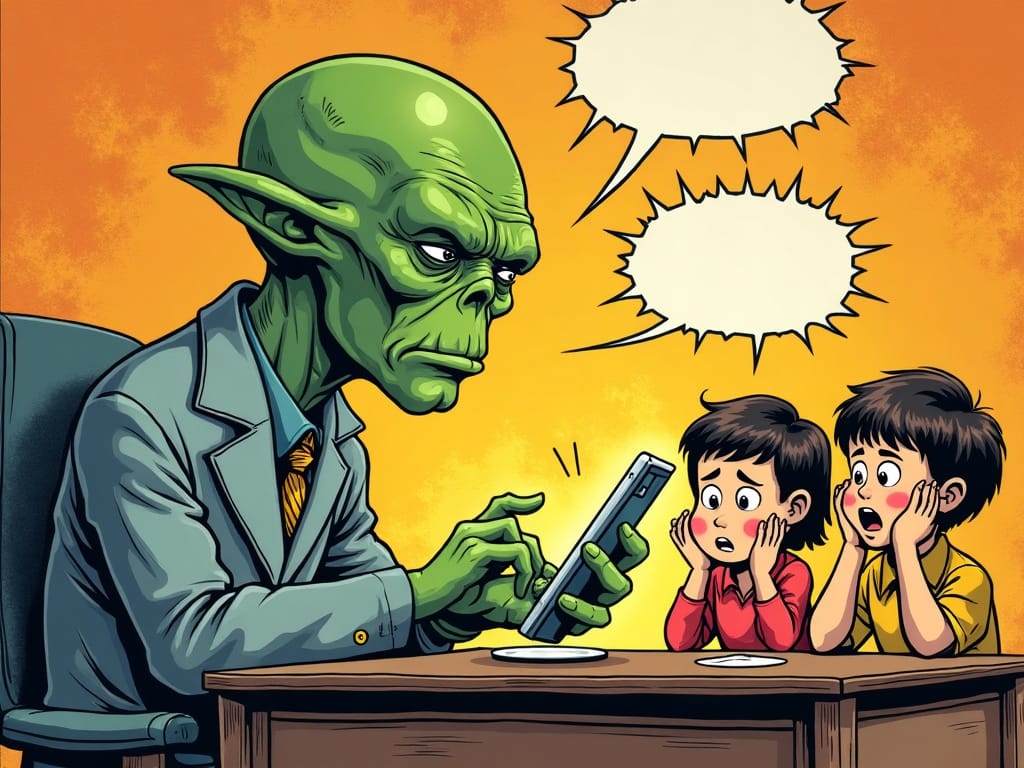
The Digital Vogon in its natural habitat. Note the empty speech bubbles. Nothing it types is worth reading either.
The Committee. Not one bully but a small social government, complete with unwritten bylaws about who is allowed to sit where and who has been voted off the island this week. The Committee never technically does anything. That is its entire design.

The Committee, in session. Agenda item one: who sits where. There is no agenda item two.
Note what every form has in common. Not size. Not meanness, exactly. An audience. A bully without an audience is just a kid having a bad day. The audience is the whole engine. Remember that, because it is the load-bearing fact of this entire guide.
The Answer Is Not 42
In the great science fiction that this guide is shamelessly borrowing its structure from, a massive computer spends millions of years computing the answer to life, the universe, and everything, and the answer comes back as a number that satisfies no one because nobody ever figured out the actual question.
Bullying has the opposite problem. We have known the question forever: how do you stop it? And we keep feeding it into the machine and getting back answers like "assembly with a motivational speaker" and "a poster in the cafeteria that says KINDNESS."
Here is the thing the posters won't tell you. The answer was never going to come from the school. Schools can respond to bullying. They can discipline it, document it, and hold assemblies about it, and Hardin County's schools genuinely try. But schools cannot make bullying uncool. That power belongs to exactly one group of people.
It's you. It was always you. Parents are the improbability drive of this whole operation.
Kids don't calibrate what's acceptable by reading the student handbook. They calibrate it by watching what the adults in their life laugh at, shrug at, repost, and say in the truck on the way home. A school can tell your kid that cruelty has consequences. Only you can make cruelty embarrassing.
The Four Excuses, Dismantled
Now, whenever this comes up, a familiar set of arguments crawls out from under the bleachers. As a public service, let's run them through the logic checker.
"Kids will be kids." This is the appeal-to-nature fallacy wearing a ball cap. Yes, kids are kids. Kids also used to ride in truck beds on the parkway and share a single water dipper during polio season. "That's just how it's always been" has never once been a reason something should continue. It is a description, not a defense.
"It builds character." Survivorship bias, table for one. The adults who say this are, by definition, the ones who came out the other side. The kids it broke are not in the room offering a counterpoint, because people generally don't grow up to give speeches about the thing that made them dread being alive at age twelve. Adversity can build character. Chores build character. A losing football season builds character. Being systematically humiliated by your peers builds something else, and we have decades of receipts on what.
"My kid would never." Statistically speaking, somebody's kid is doing it, and every single parent in the county is currently confident it isn't theirs. This is not math that works. You don't have to believe your kid is a villain. You just have to be the kind of parent whose kid knows, with total certainty, what you would think if they were. That certainty does more heavy lifting than any school policy ever written.
"It's just online, it's not real." The Digital Vogon's favorite loophole. If the money in your bank account is real and the directions in your GPS are real, then the message thread that made a kid beg to stay home this morning is real. "Online" stopped being a separate universe years ago. It's just the hallway with the lights off.
What Actually Works (The Boring, Powerful Part)
Here is the practical section, and fair warning, it is disappointingly simple. No gadgets. No apps. It's the towel of parenting: basic, unglamorous, and the single most useful thing you can carry.
Ask the second question. "How was school?" gets you "fine." That's the whole transaction. But "who'd you sit with at lunch?" or "who's getting picked on this year?" gets you actual data. Kids will report on the social weather with the accuracy of a radar system if you ask about the weather and not about them.
Make wherever your kid hears you talk a no-cruelty zone. For some families that's a dinner table. For plenty of others it's the truck on the way to practice, the drive-thru line, the bedtime phone call from the other house, or grandma's kitchen on the weekend. The location has never mattered. The rule is the same everywhere: if the adults in a kid's life roast the neighbors, mock the guy on TV, and laugh at the mean post before hitting share, that kid is taking notes, and the notes say cruelty is a family value. You cannot outsource "be kind" to the school system while running a nightly masterclass in the opposite.
Co-parenting? This is the easiest joint policy you will ever sign. A lot of Hardin County kids live between two houses, and a lot of parents reading this are running the whole operation solo. Here's the good news. This particular issue does not require a family meeting, a truce in the group chat, or agreement on a single other thing. You can disagree about bedtime, church, screen time, and whose weekend the ballgame falls on, and still send the identical message from both houses: we don't do cruel, and we stand next to the kid who's catching it. A kid who hears that twice, in two different kitchens, believes it twice as hard. And if you're doing this alone, you are not under-equipped. One adult who consistently asks the second question outweighs any number of adults who don't. Grandparents raising grandkids, aunts and uncles filling in, foster parents: you're on the roster too. Every word of this guide is yours.
Deputize the bystanders. Your kid is probably not the bully. Your kid is probably not the target. Your kid is almost certainly the audience, and the audience holds all the power. Teach them the two-second move: don't laugh, and go stand next to the kid taking it. That's it. Nobody has to throw a punch or deliver a speech. When the audience walks, the show closes. Every bully in history has been cancelled not by an administrator, but by a room that stopped finding them funny.

The two-second move. Nobody threw a punch. The show still closed.
If your kid IS the one, handle it like a grown-up. Finding out your child hurt someone is a gut punch, and the tempting moves are denial or a lawyer-grade defense of your bloodline. Skip both. The parents who calmly say "we take this seriously and it's going to stop" are doing the hardest and most respectable thing on this entire list, and every teacher in the county quietly reveres them.
Talk to the school like an ally, not like you're storming the Bastille. Teachers and principals in this county want the same thing you do. Bring them information, not a monologue. Save the monologue for the group chat. Actually, no. Don't put it in the group chat either.
Appendix A: In the Unlikely Event of a Swirly
No guide would be complete without an emergency procedures section, so here it is.
The swirly, for readers under 40, was a mid-century enhanced hydration technique involving a commode and a total failure of adult supervision. Should you encounter one in 2026:
- Remain calm. You are witnessing something rarer than a total solar eclipse. The swirly is functionally extinct, having been driven out of its habitat by hall cameras, better staffing, and the fact that modern bullies consider physical effort to be cringe.
- Know where your towel is. This is just sound advice generally.
- Document the specimen. Any working swirly encountered in the wild should be reported immediately, at which point the perpetrator will discover that the modern consequence system is considerably less funny than the 1987 version.
- Take comfort in the data. Your child is far more likely to be bullied by a poll in a group chat than by a toilet. This is what progress looks like. Progress is weird.
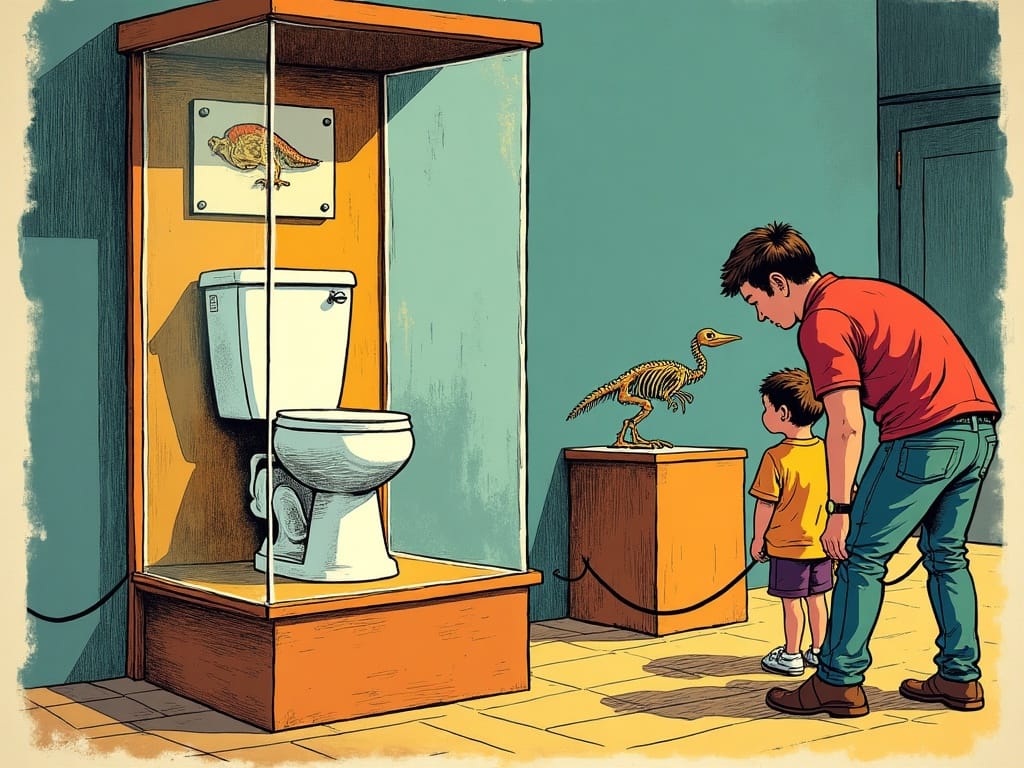
Exhibit 4B: the swirly, extinct in the wild, displayed beside its close evolutionary relative, the dodo.
The serious footnote to the funny appendix: the swirly didn't die out because kids got nicer. It died out because adults stopped tolerating it. The whole culture around it collapsed once the grown-ups quit treating it as a rite of passage. Which proves the entire thesis of this guide. Bullying is not weather. It is not a natural feature of childhood that we can only endure. It is a behavior that survives exactly as long as the surrounding adults let it, and not one minute longer.
So Long, and Thanks for All the Kids
Hardin County, here's the send-off.
This is a county that shows up. We pack fundraiser spaghetti dinners for families we barely know. We line Dixie for parades in heat that should be illegal. When somebody's barn burns or somebody's kid gets sick, this county moves like a single organism.
That is influence. That is the most powerful force in any small town, and it lives wherever this county's kids are loved: one house, two houses, grandma's place, or all of the above.
So this school year, point some of it at this. Ask the second question. Close the laugh loophole anywhere your kids can hear you. Raise an audience member who walks. If every parent, step-parent, and grandparent reading this did just that much, bullying in this county wouldn't survive until fall break, because it cannot survive contact with a community that has collectively decided it's embarrassing.
The kids came home today with new schedules, new teachers, and at least one wildly inaccurate rumor about the cafeteria menu. Have a great year, all of you.
And don't panic. But don't shrug, either.
A Note From the Author
In the interest of full disclosure, you should know exactly what kind of expert built this guide: none whatsoever. I am not a child psychiatrist. I am not a counselor or an educator, and I hold no credentials in the education system beyond a long personal history of forgetting picture day. Nobody peer-reviewed any of this. I am a parent, and if I'm being honest, an average one, which for guide-writing purposes puts me at roughly the skill level of the researchers who famously summed up our entire planet in two words and shipped it anyway.
I just watched the buses roll out this morning and thought this might help. That is the entire application. Weigh it accordingly.
Hardin Local wishes every student, teacher, bus driver, and cafeteria worker in Hardin County a great first week back. If your kid is dealing with something heavier than this article's tone, talk to your school's counselor or administration directly. They have the training this author just admitted he doesn't, they take it seriously, and so do we.